
The Story
In May of 2026, I was at a graduation party for one of my son’s high school classmates when the classmate’s father introduced me to his father, a retired architect in his late 80s. We were on a back porch in Minneapolis when he mentioned leaving the Midwest to attend the University of Pennsylvania and study architecture. I told him that I was an architect, too, that I had lived and worked in Philadelphia for 17 years, and that I had also attended Penn’s College of Design to study city planning. His eyes lit up as he told me about how he had gone to Penn to study under the famous modernist architect Louis Kahn, and then got a job working in Kahn’s office. This was clearly no distant memory, but rather the formative and central part of this man’s career and life story.
Louis “Lou” Kahn was one of the handful of world-famous modern architects, along with Le Corbusier, Ludwig Mies van der Rohe, Frank Lloyd Wright, Marcel Breuer, Oscar Niemeyer, and Alvar Aalto. Kahn died in 1974, when I was an 11-year-old kid growing up in Rochester, New York. I attended architecture school at Cornell from 1980-1985, where Wright, Corb, Mies, and Aalto were the modernists we studied the most, and Kahn was a somewhat distant fifth. But while I was in school, I worked summers and holidays at an architecture firm in my hometown, where one of my mentors was an older architect named Jim Cunningham. Jim had left Rochester to study architecture at Drexel University in Philadelphia, and I can’t remember if he worked for Lou Kahn, took a class with him, or attended one of his lectures, but he somehow got to know Kahn and had a relationship with him. In fact, Jim’s claim to fame was that when his congregation was planning to build a new church, he convinced the building committee to hire Lou Kahn, and today, the First Unitarian Church of Rochester remains one of Kahn’s most famous buildings. In Jim’s telling of the story, the best part was when Kahn flew to Rochester for the first meeting with his new client, and all the big Rochester architects were waiting to greet him at Rochester-Monroe County Airport. When Kahn walked down the steps from the airplane and started across the tarmac, it was Jim Cunningham whom he walked towards and warmly embraced, to the envy of all the others gathered there. I was probably 21 when Jim told me that story, and like me today, he was in his mid-60s then.
I decided to move to Philadelphia in 1986, so in September I bought a plane ticket, asked a Philly friend and college classmate if I could stay at his house for a week, and then started dialing for interviews from my father’s den in Rochester. I succeeded in scheduling about twenty interviews spread over five days – and after I arrived in Philly, I dropped a lot of dimes into pay phones around the city in between interviews and lined up five more, so it was roughly two each morning, two each afternoon, and one more each day for breakfast, lunch, or coffee. By the end of the week, I was a pro at interviewing, but what I remember best was the first of those 25 interviews, at 9:00 AM on a warm, September Monday morning.
It was with an architect who had both his home and office in a converted carriage house in Center City, near Fitler Square. It was a beautiful place and very carefully designed, like a piece of cabinetry. After the interview, he gave me a tour of the whole place, but he asked questions along the way about how a door worked or where a light switch was concealed, and I slowly came to realize it was a sort of game or test. It ended in the third-floor bathroom where he asked,
“And where do you think the medicine cabinet is?”
By this time, I remember feeling stressed, until he pressed the hidden latch and the cabinet popped open. A few years later, I was telling this story to some architect friends, and before I got to the end, one guy said, “Were you able to find the medicine cabinet?” That’s when I realized I wasn’t the first, or last, to go through that unique gauntlet. One thing the architect showed me on our tour was some beautiful drawings for a huge, new classically styled mansion for a Wall Street stock trader. Unfortunately, that client had just recently been caught in an insider trading scandal, was soon convicted of felony crimes, and ultimately did some jail time, all of which explained why the architect’s project was on hold when he showed it to me.
But the most memorable part of the experience was when we were sitting in his office talking. He had grown up on the “Main Line”—the train line that serves the affluent suburbs—and he was a classic teeth-talking Philadelphia blueblood, like Thurston Howell III, from Gilligan’s Island. I knew from previous experience that the best question you can ask in an interview is “tell me about yourself.” So when I asked him to tell me about himself, I remember him leaning back in his chair, with his hands clasped behind his head (I don’t think he actually put his feet up on the desk, but he may as well have), and said,
“Well, you see, daddy was in publishing.”
After talking about his education, he mentioned working in Lou Kahn’s office, and then he said,
“Back when Lou and I were designing the Salk….”
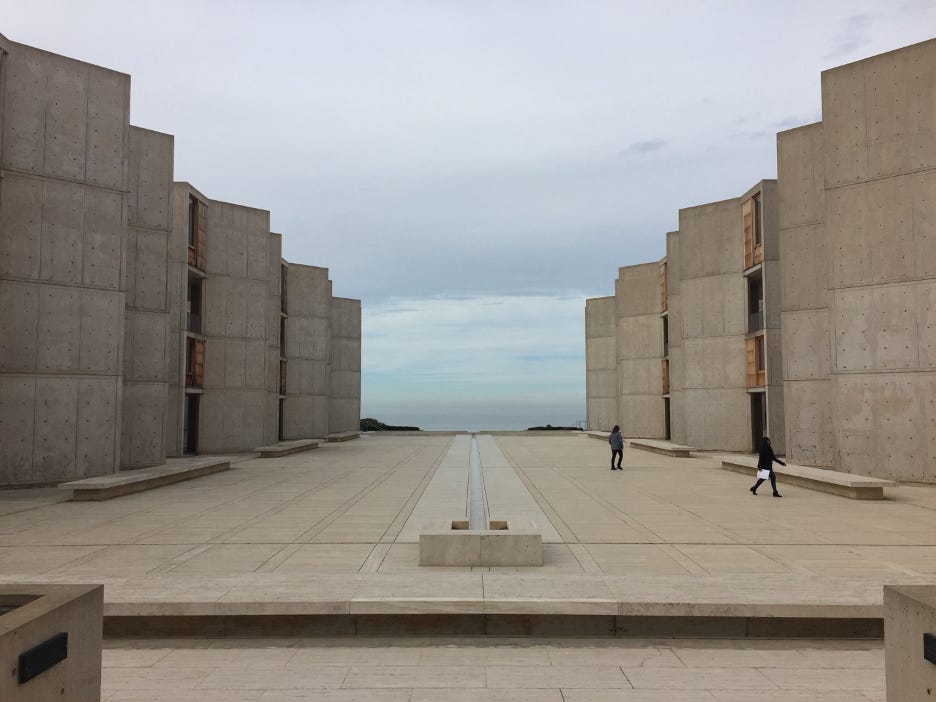
The Salk Institute in La Jolla, California, is one of Kahn’s most easily recognized, famous, and photographed buildings, and it has won multiple design awards over the years. When he started talking about Kahn, I went on high alert, because I had not yet realized that while Kahn was not a central figure at Cornell, he was huge in Philadelphia, where he lived, ran his firm, and taught design studio at the University of Pennsylvania. But more importantly, while I might have been a little naïve, I still remember wondering, “Would you say that kind of thing if Lou were still alive and standing right there next to you?” I mean, was this guy a critical member of the design team or was he just sharpening Lou’s pencils? We may never know, but I can tell you, I heard a lot about Lou Kahn that week in those remaining 24 interviews, from a surprisingly large number of people who claimed to have been deeply involved in Kahn’s most famous designs.
I got two job offers that week, accepted one, and when I got back home to Rochester and was getting ready to move, I made a note to myself to get more acquainted with the man and his legacy. At the time, Philadelphia was also the home of several other important and internationally known firms. Venturi, Rauch, and Scott-Brown (VRSB), led by Robert Venturi and Denise Scott-Brown, was a hotbed of design innovation, postmodern design, city planning, and brilliant intellectual thought leadership. For me, Denise Scott Brown remains one of the only architects whose writing I can actually read and enjoy, and for decades that firm was an incubator for talented architects who have since gone off and started their own well-regarded practices. Robert Venturi passed away in 2018, and Denise Scott Brown is now in her mid-90s, so while the firm lives on as VSBA, it’s not the influential practice it was when I moved to Philly. The firm of Mitchell Giurgola was another internationally known design firm based in Philadelphia, and in the 1980s they were the architects for the new Australian Houses of Parliament in Canberra, a big, prominent project. The firm’s founding partners, Ehrman Mitchell and Romaldo Giurgola, are both long gone now, although two very good but unaffiliated successor firms continue to operate in Philly and New York. As I write this now, it all sounds like dry and dusty ancient history, but if, like me, you were moving to Philadelphia in the 1980s to work in architecture, you needed to know a little something about Lou Kahn, VRSB, Mitchell Giurgola, and the other firms that made up “The Philadelphia School,” if you hoped to get a job with any of them, or at any other firm in town that was peopled by their acolytes.
In addition to his architecture, Lou Kahn famously had a complex personal life. He was married to one woman, had long-term extramarital affairs with two others, and had three children, one with each. Years later I briefly dated a woman who lived next door to one of Kahn’s other partners. A few years after that, when I was the president of the Philadelphia Chapter of the American Institute of Architects, I had the honor of introducing filmmaker Nathanial Kahn when he screened his Academy Award-nominated documentary, My Architect: A Son’s Journey, which was about his experience being the child of one of the women and the ambivalent feelings he had about his distant father and extended family.
One of the funny and lesser-known things about the making of the film was the subsurface competition that took place between some old Philadelphia architects who had worked for Kahn, in terms of who was interviewed for the film, who wasn’t, and who got more screen time. One architect I knew who appeared several times in the film was very proud and talked quite a bit about it to all who would listen. Like my friend’s father, for him, having worked for Kahn at a young age remained the highlight of his life and career.
It’s now been 40 years since that job interview with the Mainline architect on that warm Monday morning in September of 1986, and 23 years since I moved away from Philadelphia, and I suspect that soon there will be no one left alive who can claim to have worked alongside Kahn, which makes me a little sad. And it brings me back to that porch in Minneapolis a few months ago, and that conversation with that 80-something-year-old architect who, as a young man, worked for Kahn. We are separated in age by about 25 years, but there was enough overlap to play the name game. In addition to Kahn, he mentioned having known the city’s famous city planning director, Edmund Bacon, father of the actor, Kevin. Back in the 1960s, Bacon planned Society Hill, attracting a young I.M. Pei to design the modern townhomes and high-rises nestled into what is now a rehabilitated historic district. I mentioned that for 15 years I lived three doors down from Bacon on Locust Street, so I guess I can claim two degrees of separation from Kevin Bacon, although I never once saw him. Then my friend’s father mentioned having worked in the office of Oscar Stonorov, another famous modernist architect active in Philadelphia from the 1940s until his premature death in a plane crash in 1970. And then suddenly, I felt old. I hadn’t heard that name in decades, and I didn’t know much else about him other than he had done some forward-looking, modernist public housing. He was not as famous as Lou Kahn, but he, too, was an important member of The Philadelphia School, and yet, if I had to guess, few young architects in Philadelphia today have ever heard of him.
This fall is the 40th anniversary of the year I left home and started my new, independent adult life in the City of Philadelphia, and I’ve been filled with wonder at how it seems like only yesterday. I have a friend who is in his late 70s who recently said to me, “Peter, I have had to come to grips with the fact that I am no longer getting old; I am old.” Personally, I don’t feel old yet, but it does feel strange when you can remember the name of a once famous person whose work and legacy have been all but forgotten by almost everyone else.
“You say to a brick, ‘What do you want, brick?’ And brick says to you, ‘I like an arch.’ And you say to brick, ‘Look, I want one, too, but arches are expensive and I can use a concrete lintel.’ And then you say: ‘What do you think of that, brick?’ Brick says: ‘I like an arch.”
- Louis Kahn
“Were you able to find the medicine cabinet?”
- A Philadelphia architect I once knew
I thank Joanne Aitken, a long-time Philadelphia architect and friend, for reading several drafts of this post, making some helpful suggestions, and sharing her own perspective and insights on the big Philadelphia architects and firms of the 1980s.