Secret Mall Apartment
Figure-Ground, Poché, and Figural Space

The Story
During a break at a recent meeting of city planners, several of my colleagues were raving about a 2024 documentary called Secret Mall Apartment, one of the top five most-watched programs on Netflix. Since our meeting had been on Friday, I decided to watch it the very next day, on Saturday morning. The story is about an art instructor at the Rhode Island School of Design named Michael Townsend, who specialized in large-scale, installation art. In the early 2000s, the city of Providence embarked upon a big urban redevelopment program, and the anchor project was an enormous new mall in the heart of the city called Providence Place. As he watched the mall being constructed, Townsend grew certain that there was an odd, leftover interior space at the joint between two parts of the building, near the roof. One day, after the mall opened, he slipped through an exit door, into a back-of-house service area, and wound his way down corridors, up stairways, and through the building. Finally, at the top of a tall ship’s ladder, he found that otherwise inaccessible and unused space, and decided that his next project would be converting it into an apartment. Townsend recruited some former students, and over time, they smuggled in furniture, rugs, lamps, extension cords, a microwave, a TV set, and even video games. They also spent more and more time hanging out in their new home. This went on for four years, until Townsend was caught by the mall’s owners, charged with trespassing, and barred from the premises for life. By this time, however, he and his friends had fully documented the process of creating and inhabiting their grand piece of installation art. (And let me say that I recommend this movie—it is interesting, fun, and it addresses a handful of social issues beyond art, like gentrification, capitalism, and sticking it to the man, generally.) Anyhow, Townsend and his friends’ Secret Mall Apartment occupied what the Dutch architect Rem Koolhaas calls “junk space” or what architects call “space left out in planning,” or “SLOIP,” but I’m going to use it as an introduction to the concept of “poché.” Before we talk about what that word means, however, we need to start with the “figure-ground principle.”
The Theory
Figure-ground: Gestalt psychology’s figure-ground principle explains how our mind and, more specifically, our visual system interprets images by focusing on the figural shapes and dismissing the messy context or background. When presented with a black & white image, the mind typically defaults to reading the black as figure or solid, and the white as background or void, but white can be the figure too. The classic example is called the “Rubin Vase," an image of what appears to be a vase or candlestick (in white), where the ground or black areas can be interpreted as two opposing faces in profile. It may take some cognitive effort to see the two opposing faces and not the candlestick, but seeing figure and ground is a fundamental cognitive skill that helps separate objects from the background, for example, the outline of a pair of scissors in a junk drawer.1


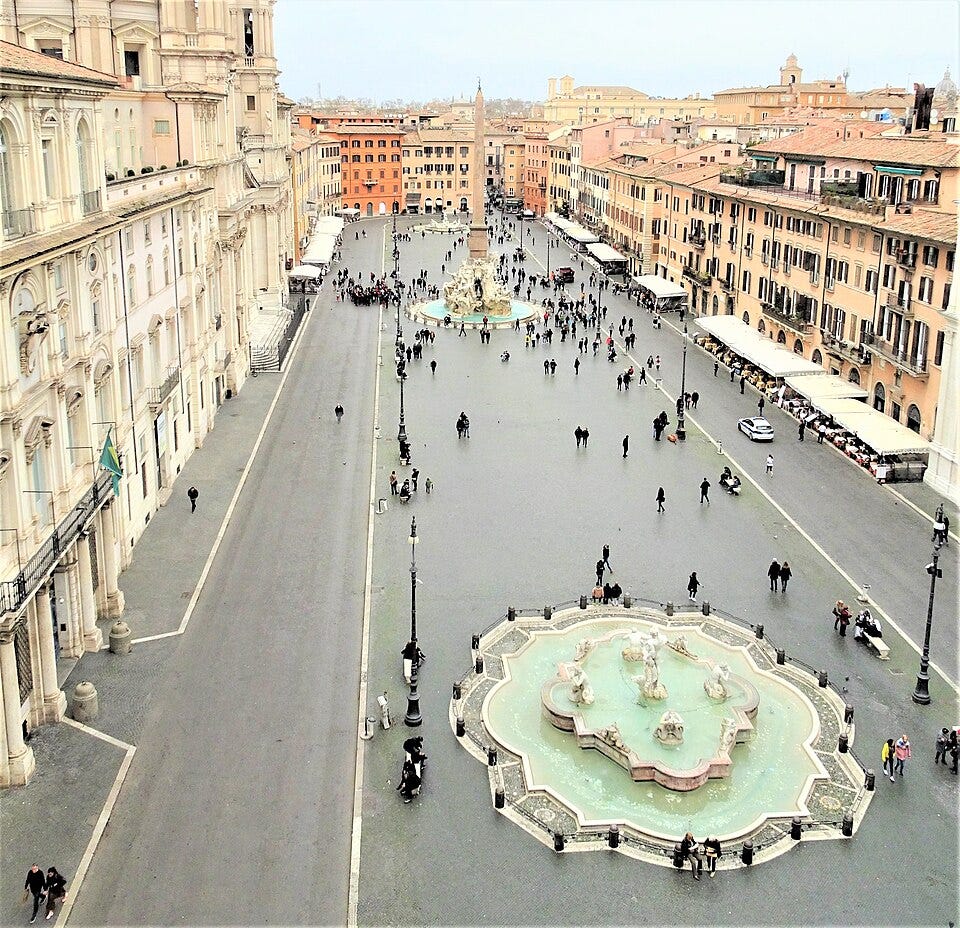
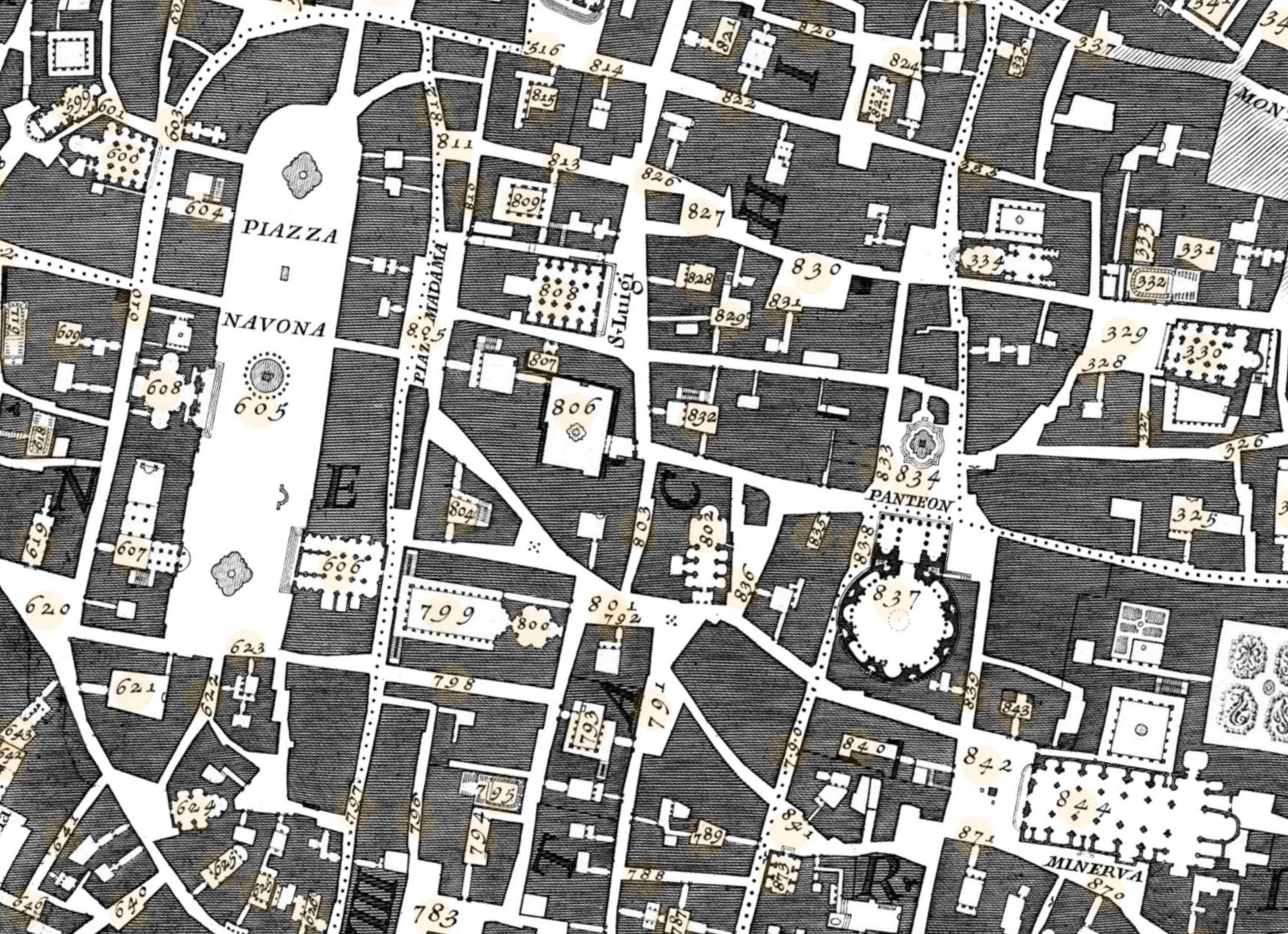
Architects use the figure-ground principle to create plans and maps of cities, where buildings are solid black and streets, plazas, and other outdoor spaces are white. The best example of this is the 1748 Nolli Map of Rome (I encourage you to visit the wonderful Interactive Nolli Map of Rome), which shows both outdoor public spaces and the major spaces inside churches and public buildings in white, while the rest of the buildings are black. Rome is a very old city, built on seven hills with the Tiber River snaking through the center, so topography and natural features mean that there is no regular street grid, and private buildings and properties are more often odd-shaped, with their public facades forming continuous street walls. Streets like the Via di Ripetta, Via Del Corso, and Via dei Due Macelli serve as arteries connecting the major public spaces—figural shapes including squares, rectangles, circles, ovals, and ellipses, in the cases of the Piazza Navona, Piazza del Popolo, Piazza di Spagna, and the Piazza della Rotonda, in front of the Pantheon. The Nolli plan illustrates how all these white shapes connect to form a network of spaces and a legible public realm.
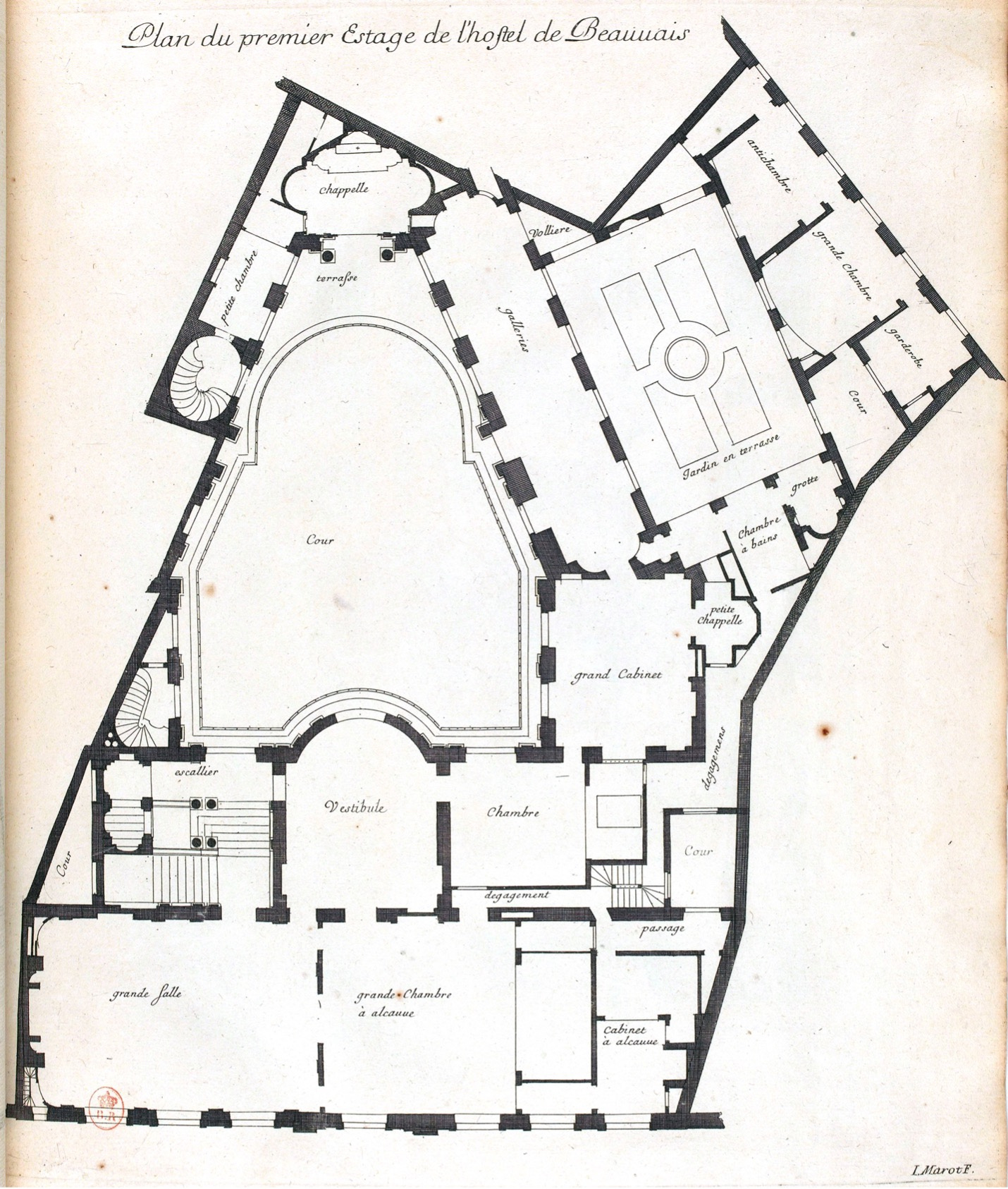
Poché: The principle of figure-ground can be applied to individual buildings, too, where important rooms are figural—again, squares, rectangles, circles, ovals, and ellipses—and secondary spaces and walls are the solid background that make up for odd conditions between the street, neighboring properties, and the building interior. This solid background is called “poché,” which is the French word for “pocket” or “pocketed.” This is one of several fancy French words architects bandy about—another is “Parti”—and we used it all the time when I was in school, but practicing architects rarely use the word poché, and, I confess, other than writing this essay, I don’t think I’ve used the word in 20 or 30 years. That having been said, the idea of poché is really important and helpful when thinking about design. Anyhow, when an architect draws a floor plan, they draw two lines to make a wall, representing the two sides or faces of the wall, and then hatch or color in the space between the two lines in black to show the wall’s thickness, and that is the poché. In premodern times, when buildings were built of load-bearing masonry, a building’s structure—piers, columns, walls, chimneys, and filler material—was solid and quite thick. In a floor plan, all the non-space between the figural spaces is the poché, a word which has both physical and theoretical connotations. Physically, poché is the solid mass that both separates and creates the formal, idealized rooms of the interior, mediating between the messy and chaotic public street and the peaceful private residence. Theoretically, poché reconciles the irregular geometries of an imperfect site by combining ideal figural shapes in plan with the deliberate design of vertical facades to provide clear, bounded, symmetrical, and geometric spaces that provide a sense of place and enclosure.2
Yet not all poché is solid, and much of it contains service areas, including hidden passageways, stairs, storage spaces, and other back-of-house functions. A wonderful example can be found in the movie, The Remains of the Day, which is based on Kazuo Ishiguro’s Booker Prize-winning novel of the same name. The story unfolds inside Darlington Hall, a big manor house in England, before World War II. The house has both grand rooms and a warren of hidden backstairs and passageways, trafficked by an army of people cooking, serving, cleaning, and making beds, while remaining largely out of sight. The protagonist is a head butler named Stevens, played by Anthony Hopkins, who considers his service and dedication to his master such a high calling that he is unwilling to acknowledge the mutual love that has grown between him and Miss Kenton, the head housekeeper, played by Emma Thompson. At one point, Miss Kenton finds Stevens in the library reading a book, and when she suggests that it’s something racy, he responds that he’s trying to improve his English. When she presses closer to him and asks him to show her the book, trapping him by blocking the doorway, the repressed and avoidant Stevens, unable to seize this one opportunity for happiness, ends the conversation by pushing on a bookcase—a hidden door that swings open—and slipping out of the room and away, into the bowels of the manor, leaving the surprised Miss Kenton all alone. Stevens slips from a figural space, the formal library, into the poché, and to their mutual regret, they never do get together.
Figural Space: When I was in architecture school, there was a professor named Michael Dennis who had written a draft of a book that remained unpublished at the time, but circulated for years in the form of a very influential, albeit underground, xerox copied, double-spaced typed manuscript, then known among students and faculty as “The French Hôtel Book” (a French hôtel is a private townhouse). Court & Garden: From the French Hôtel to the City of Modern Architecture was finally published in 1985, and in it, Dennis illustrates how the traditional French Hôtel relies on poché for both the ordering of floor plans and the creation of spaces, with the prime example being the Hôtel de Beauvais:3
“In urban design terms, the building fills the highly irregular site, as if poured into it, and maintains the continuity of the street to form a kind of urban poché, out of which the central figure of the courtyard appears to be carved.”
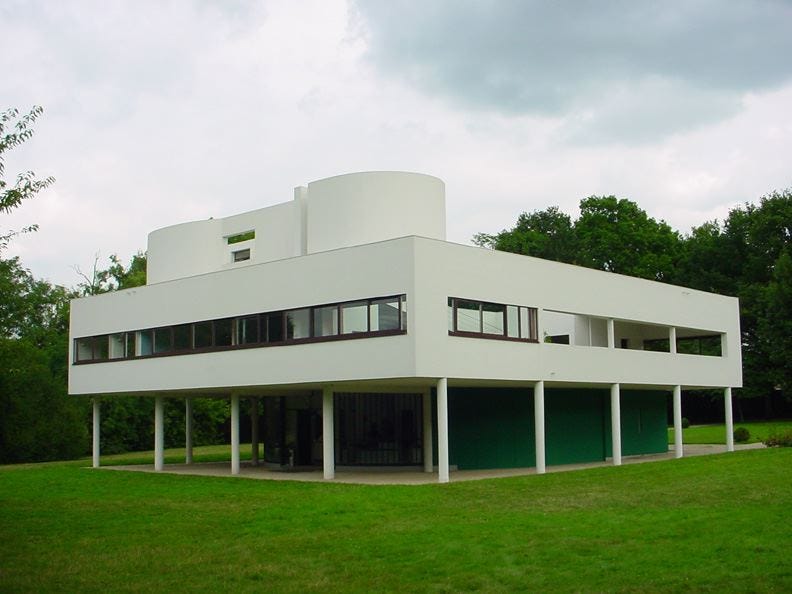
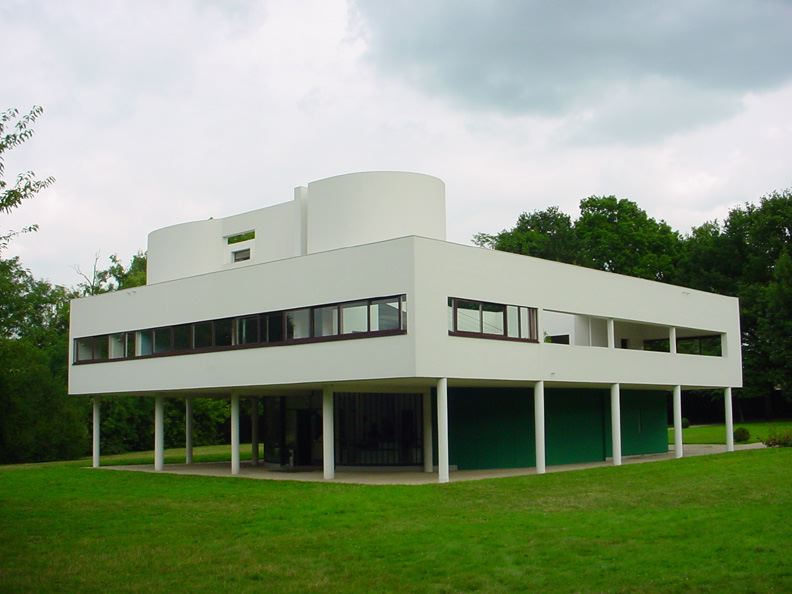
But in the early twentieth century, technological innovations, including steel frame construction and the elevator, eliminated the need for all that masonry mass that had previously served as structure. This led to the French Modernist Architect Le Corbusier’s idea of the “Plan Libre” or free plan, in which the only constraints on a floor plan were widely spaced columns and stairs. As a result, the poché in modern buildings is made of thin, non-load-bearing walls that serve more as membranes between spaces, while hiding drinking fountains, fire-extinguisher cabinets, bathrooms, fire stairs, and vertical shafts for electrical, plumbing, and mechanical systems. Along with these modern technologies came a shift from the traditional emphasis on formal urban spaces to modernism’s emphasis on formal object buildings, reversing figure and ground at the expense of the public realm. Here is Dennis’s characterization of that inversion:
“If the traditional plan can be seen as concave voids carved out of a solid, the new plans may be seen as convex solids inserted into a space. In the old plan, the spaces were figural, and the solids served as ground.”
And here’s how he sums up the problem created by it:
“For centuries, space was the principal medium of urbanism—the matrix that united public and private interests in the city, guaranteeing a balance between the two. But in the eighteenth century, a process of change—social, intellectual, and formal—began to alter the balance in favor of the private realm. Freestanding object buildings began to replace enclosed public space as the focus of architectural thought, and despite some resistance during the nineteenth century, this formal transformation—from public space to private icon—was finally completed in the early twentieth century. The demise of the public realm was then assured.”
Dennis was concerned with how modern architecture had sacrificed traditional public space for the private object building, and his thesis combined the evolution of the French hôtel plan from 1550 to 1800 with a critique of the limits of modernism to make a powerful argument for the return to the use of poché to define urban public space.
The Lesson
Start paying more attention to the figural spaces in your city and the buildings where you spend your time. Outdoors, these may be the plaza in front of a government building or a university quadrangle, where one grand façade and the façades of the other surrounding buildings together create a street wall that defines the space. Inside, look around in museums, performing arts centers, libraries, and other civic buildings, and see the grand figural spaces, but also notice where bathrooms, stairs, and other things are tucked away. The best spaces, inside and out, are figural spaces with clear geometries and good proportions, and when you are in a really well-designed space, you can physically feel the rightness of it.
“But the façade as a mask, or mediator, between the public and private realms was without a doubt latently contradictory to the idea of the free plan, and consequently, the demise of the vertical surface as an architectural and urbanistic concern was ultimately inevitable.”
- Michael Dennis, in Court and Garden
“I appreciate your kindness, Miss Kenton, but I prefer to keep things as they are.”
- Anthony Hopkins, as Stevens, in The Remains of the Day
My thanks to Wikipedia for clear summaries of the concepts of figure-ground and poché.
Ibid.
Dennis, Michael, Court & Garden: From the French Hôtel to the City of Modern Architecture, Cambridge, MA: MIT Press, 1986.