
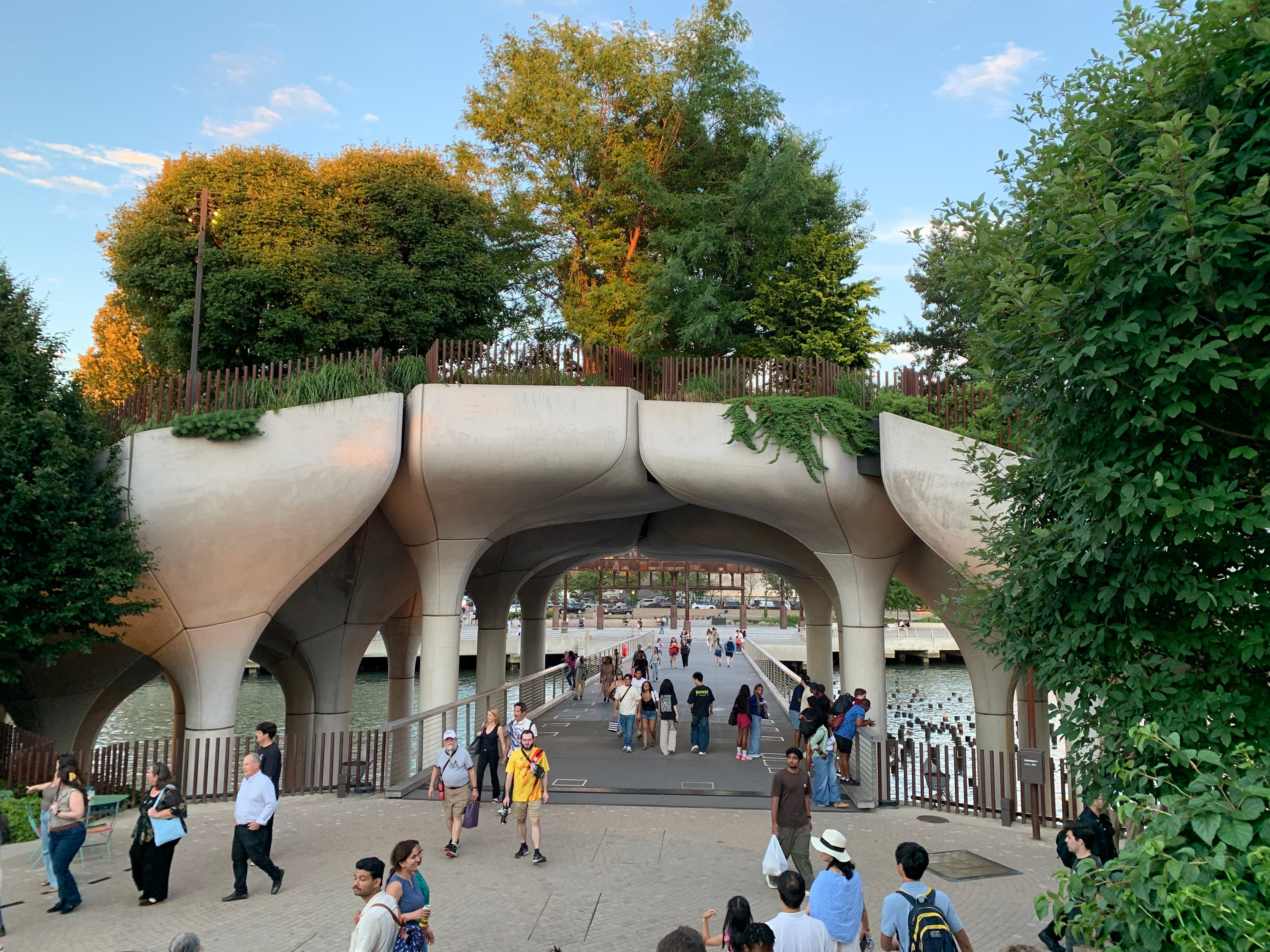
The Story
After working on a handful of park, plaza, and street projects for the city of Minneapolis, I approached the associate dean with the idea of teaching a course called “planning and design for the urban public realm.” I felt like I had some important lessons to impart to our planning students before I forgot everything I had learned, and she liked the idea and gave it the green light. I taught the course for four years and brought project participants to class, along with my own experiences and perspectives. One perspective came from presenting in meetings where wealthy individuals and powerful business leaders often had a big say in the planning and design of these projects for public places. These were all “public-private partnerships,” where a share of the funding came from assessments on private property owners or from generous gifts from foundations and individuals. The use of PPPs has grown over the past half century as a way to fund and complete public projects, but I confess, I’ve grown increasingly queasy about the whole idea, and particularly, how public these things really are.
One day in class, while I was talking about how public realm projects are funded, I showed some photos of the “Little Island” park, in Manhattan, which was completed and opened to the public in May of 2021. This is a 2.4-acre landscape park built over the Hudson River on piles capped with tulip-shaped forms that connect along their edges, creating a continuous surface while providing the soil volume below for the trees and landscaping. It is a uniquely striking and innovative design. I explained to my students that media mogul Barry Diller, who made his money through consolidation and cost-cutting in the media business, and his wife, fashion designer Diane von Furstenberg, had hired the star architect Thomas Heatherwick to design the park. Diller paid $243 million, over 90% of the project’s $260 million total project cost, and also established a fund to pay for twenty years of operations. Then I asked my students what they thought of that. Their initial reactions were along the lines of “cool!” and “it’s the least a billionaire could do, so let’s take it.” But as the wheels started turning in their heads, they grew more skeptical.
To be clear, this is a project where a billionaire donor directly hired an architect of his choosing, strong-armed the city into contributing a valuable piece of riverfront property, and extracted an additional $17 million worth of infrastructure improvements from the city, all while bypassing the typical planning process. When the project ran into political headwinds, state and local elected officials helped shield Diller from criticism and smooth the path of the project to ensure its completion. Justin Davidson summed it up succinctly in New York Magazine, concluding that the Little Island was:
“A project born of one rich man’s whim, nurtured by a few officials, and forced through a public process designed to bless it, not judge it.”1
Just to put the Little Island’s cost into perspective, a typical urban signature park (for example, parks built on decks, over parking, or on waterfronts) costs between $5 million and $20 million per acre, as compared to the Little Island, which cost an eye-watering $108 million per acre. At this point, a reasonable person might ask, “is this the best way to spend money on New York City parks, or are there other places in the city that could have used a share of those funds to improve existing parks?” Another critic, Henry Grabar at Slate, summed up the effects of not just this one project, but the trend towards icon-funded civic monuments:
“The corrosive long-term consequence is that private money flows in ever-larger amounts to flagship parks while support for taxes ebbs, inequalities grow between public spaces in rich and poor neighborhoods, and government is made the caretaker of last resort. At those parks dependent on philanthropy, meanwhile, donors dictate the path of new investment.”2
The Theory
In a book called From Predators to Icons: Exposing The Myth of the Business Hero, French sociologists Michel Villette and Catherine Vuillermot study the lives and careers of over ninety very wealthy and very successful French and American businessmen from Bernard Arnault, the leader of luxury group LVMH (Louis Vuitton Moët Hennessy), to Ikea’s Ingvar Kamprad, Microsoft’s Bill Gates and Wal-Mart’s Sam Walton. But rather than taking an economistic viewpoint, the authors look through a sociological lens to study how successful businesspeople use political and social action to identify and exploit opportunities.3
The book exposes how successful businesspeople start out using “predation” to earn their profits and then, as they accumulate enough wealth, pivot and transform themselves into “icons.” When they are starting out, businessmen engage in a political pursuit that involves developing and cultivating relations with important government representatives and others who can help in “doing deals.” Villette and Vuillermot break down the process of doing a good deal into six stages. First, the businessman puts himself in “between” (entre) in order to “take” (prendre). Second, he arranges a stream of separate transactions. Third, he uses a combination of “promises, gifts, exchanges, and threats” to ensure that members of his team, partners, resource providers, and other allies remain in line and supportive of his strategy at all costs. Fourth, he conceals his estimates of the value of individual and combined resources from members of his team and other businessmen, ensuring that they remain in the dark and do not arrive at the same estimates. Fifth, he avoids sending “premature signals” to potential imitators, other competitors, politicians, and government agencies. And last, once the transaction is complete, he spends the minimum amount of money required to make reparations – to those he has broken promises with – and to cover his tracks with regulatory agencies while protecting his reputation. At this point, the successful predator is a well-known public figure with a sketchy reputation.
Once the business hero has accumulated enough wealth to cement his success, he pivots to the icon phase, spending extravagantly on philanthropy, public relations, and business history narratives, and the creation and funding of civic monuments, all in the hopes of cleansing his former reputation for ruthless rapaciousness. As profits grow, the predator can begin to spread it around, funding his own favorite interests and relying on political connections to make his deals run smoothly. During the icon phase, the business hero uses his capital to whitewash his image, buy social and civic legitimacy, and to deal himself in at the table of civic leadership. As the authors conclude,
“Only at the end of his life does he alone become the generous exception that confirms the general rule of the grim search for profit. He alone has accumulated enough money to offer himself redemption and to demonstrate his moral superiority after having established his financial supremacy.”
With this moral superiority, the predator uses his economic and political power to reshape the world to his own designs and resuscitate his own reputation in the process. By sharing his own wealth, the heroic businessman becomes an icon, and then,
“Like a good prince, he redistributes wealth, but on his own terms, through foundations and sponsorships. After having conquered economic power, he transforms it into political, social, moral, and cultural power, selects his poor, his sports figures, his artists, his candidates for excellence, or even his rebels, whose subsidized superficial subversions will permanently fill up the possible spaces for subversion.”
Does this sound like a good way to build a city?
The Lesson
I admit it, I’m not just queasy about this kind of project; in fact, I think the whole process stinks. Does it make sense that billionaires are using projects like the Little Island to rejuvenate their reputations, while forcing the larger public to accept their vision—and their taste—at the expense of a more balanced distribution of resources that leads to better parks for all residents of a city? Or more simply, how many trees could be planted in New York’s many existing parks for $260 million? Why do we have billionaires—and now trillionaires—influencing government policy and decision-making, and do we really think they are in it to do good for anyone other than themselves?
I don’t know Mr. Diller, and perhaps it was a generous gesture, but he and his park sure do fit the predator/icon mold, and either way, I would rather people like him make less money and pay more in taxes. Finally, I struggle mightily with the presumption that “business heroes,” because of their commercial successes, see themselves—and are seen by others—as omniscient and omnipotent in matters well beyond their own areas of expertise and experience. Frankly, I trust our citizens and our governments more to do a better job of deciding how to distribute those resources and plan for our cities.
What do you see in your city? Who are your current icons, and can you remember when they were predators? Which of their civic monuments can you identify? And how do YOU think our parks should be funded and built?
“It’s only in the context of our radically diminished expectations for existing civic infrastructure that vanity projects like Little Island can look like public gifts at all.”
- Michael Friedrich, in The Baffler4
“There are less glamorous parks all over New York dying, literally, for the lack of a fraction of such funding.”
- Henry Grabar
“I don’t think that we should have billionaires”
- New York City Mayor Zohran Mamdani
Davidson, Justin, "Little Island, Big Question," in New York Magazine (Vulture), published on November 12, 2014.
Grabar, Henry, “The Big Problem with Little Island,” in Slate, published June 7, 2021.
Villette, Michel and Catherine Vuillermot, From Predators to Icons: The Myth of the Business Hero, Ithaca, New York: Cornell University Press, 2009.
Friedrich, Michael, “Escape from Little Island,” in The Baffler, published June 10, 2021.