
The Story
When I left private sector architectural practice for Philadelphia city government, my new job gave me a window onto an aspect of city-building that I had never had any exposure to: the role that special purpose governments play in promoting and funding major economic development projects. I started to notice how all the big, interesting projects around town were public-private partnerships with some share of their funding being provided by revenue bonds sold by one of the twenty or more public authorities operating in the city. Among other things, I became fascinated with the question of why a big agency called the Delaware River Port Authority had financed a new Triple-A ballpark, a state aquarium, a new office building, a marina, a light rail line, and some other baubles on the Camden waterfront, when the organization’s name suggested its primary mission had to do with cargo handling, which it didn’t really do anyhow. I believe that in life, you should follow your curiosity, and my curiosity led me back to graduate school for planning.
That meant spending a lot of time in the library, reading a lot of books and even more double-blind, peer-reviewed journal articles, most of which are written in a stultifying academic style that often obscures the main idea. And while style isn’t everything, it matters, so it is always a pleasure to come across something that makes an interesting and compelling new argument, and reads well, too. So I was delighted when, one day in my library carrel, I discovered amidst that day’s big pile of Xerox-copied academic articles, a glittering little gem, called “The City as a Growth Machine: Toward a Political Economy of Place,” written in 1976 by a sociologist named Harvey Molotch. As I read it, this article resonated with me, and I said to myself, “Now THAT’s what I’m talking about!”1
The Theory
About ten years later, I was weeding out 18 banker’s boxes worth of old papers, articles, and interview notes from grad school and my dissertation, four of which had Post-it notes taped to them that said “UPE,” my personal acronym for “Urban Political Economy.” This is an interdisciplinary field of research that considers how power, economics, and institutions come together to influence the growth, spatial arrangement, and governance of a city. With that 1976 article and the introduction of his “Urban Growth Machine” thesis, Harvey Molotch initiated the search for a theory of urban political economy that went beyond a purely economistic view of the city to incorporate place and politics in an explanation of who governs in urban areas.
In Molotch’s view of the city, the Urban Growth Machine constantly rearranges land use to increase the utility of urban land. As a result, the map of the city represents an “interest mosaic,” and government becomes the arena within which “nested” landowner interest groups at the street, neighborhood, district, and city level compete for the scarce resources that represent the preconditions of growth. Growth is promoted by a group of actors who do not represent the general population, but who enter the political realm because they are interested in the politics around the distribution of services, including land, that are typically negotiated in private. These elites, who include developers, builders, chambers of commerce, and other “statesmen” of the growth machine, such as local newspapers and universities, rely on the key ideological prop of “growth makes jobs,” and for whom, “Growth provides the crucial ‘glue’ that holds together the otherwise competing local elites...”
But Molotch also points out that growth is not a pure good and that, further, it can lead to a “zero-sum game” and competition between localities, where policies that encourage companies to relocate result in ghost towns and under-utilized capital stock in urban areas.
In 1987, Molotch and John Logan published a book called Urban Fortunes, which further advanced the growth machine thesis by focusing not on the neoclassical economist’s view of property as a commodity, but on how markets work as social phenomenon. Logan and Molotch argued that property in urban areas has both exchange value and use value (see episode 6), and that economic development is not necessarily good for the entire city, as it can result in rising rents, costs to the environment, and other social costs such as displacement. Logan and Molotch concluded that
“For those who control the machine, place is a source of rent; for residents, place is where they live out their lives. These two sets of interests clash at almost every turn.”2
Molotch’s Growth Machine thesis reinvigorated the discipline of Urban Political Economy and a new canon of research has grown up around it, leading to a 1999 edited collection of essays called The Urban Growth Machine: Critical Perspectives Two Decades Later. Recognizing the 20th anniversary of the publishing of Molotch’s original article, the essays in this volume explore different variations and outgrowths of the growth machine thesis, including one of my favorites, which expands beyond growth to address “boosterism.”3
In “Growth Machines and Propaganda Projects,” Mark Boyle expresses concern with the contemporary role of civic boosterism in the politics of local economic development. Boyle consolidates the gamut of activity described variously as “civic jingoism,” “local boosterism,” “the flagship project,” “the urban spectacle,” “the hallmark event,” and “place promotion” under a single heading that he calls the “Urban Propaganda Project,” or “UPP.” Technically, UPP’s are supported with the usual combination of tax abatements, tax increment financing, other development incentives, and supporting infrastructure. But according to Boyle, UPP’s are also used to create enduring identities for cities that may, for example, be based upon the birthplace of a famous person, the best football team, or some cultural attraction. In some cases, they may even be used for “the construction of a heritage” where one does not yet exist.4
Boyle then describes how downtown business coalitions comprised of the same actors identified by Molotch use UPP’s as instruments of local control in two ways. First, UPP’s seek to reduce the conflict between growth elites and residents by de-emphasizing the connection between growth and exchange value, or the way resources are allocated in a city. At the same time, UPPs emphasize the connection between growth goals and better lives for the majority. Second, UPP’s are used to appropriate local sources of civic pride as part of the legitimization of the growth coalition agenda, for whom growth is cause for celebration, since it is good for everyone, including business, workers, homeowners, and politicians, since it increases tax revenues, and even the unemployed, who benefit from the jobs created by UPP’s. The consolidation of these two uses of UPP’s is accomplished by appealing to what Molotch originally called the community “we” feeling, a tactic which serves another purpose of the growth coalition by effectively muting any opposition, since it’s hard to be against “we.” According to Boyle, this is how the business coalition mobilizes the concepts of “community” and “local identity” in the manufacturing of a local consciousness that supports their growth activities.
The Lesson
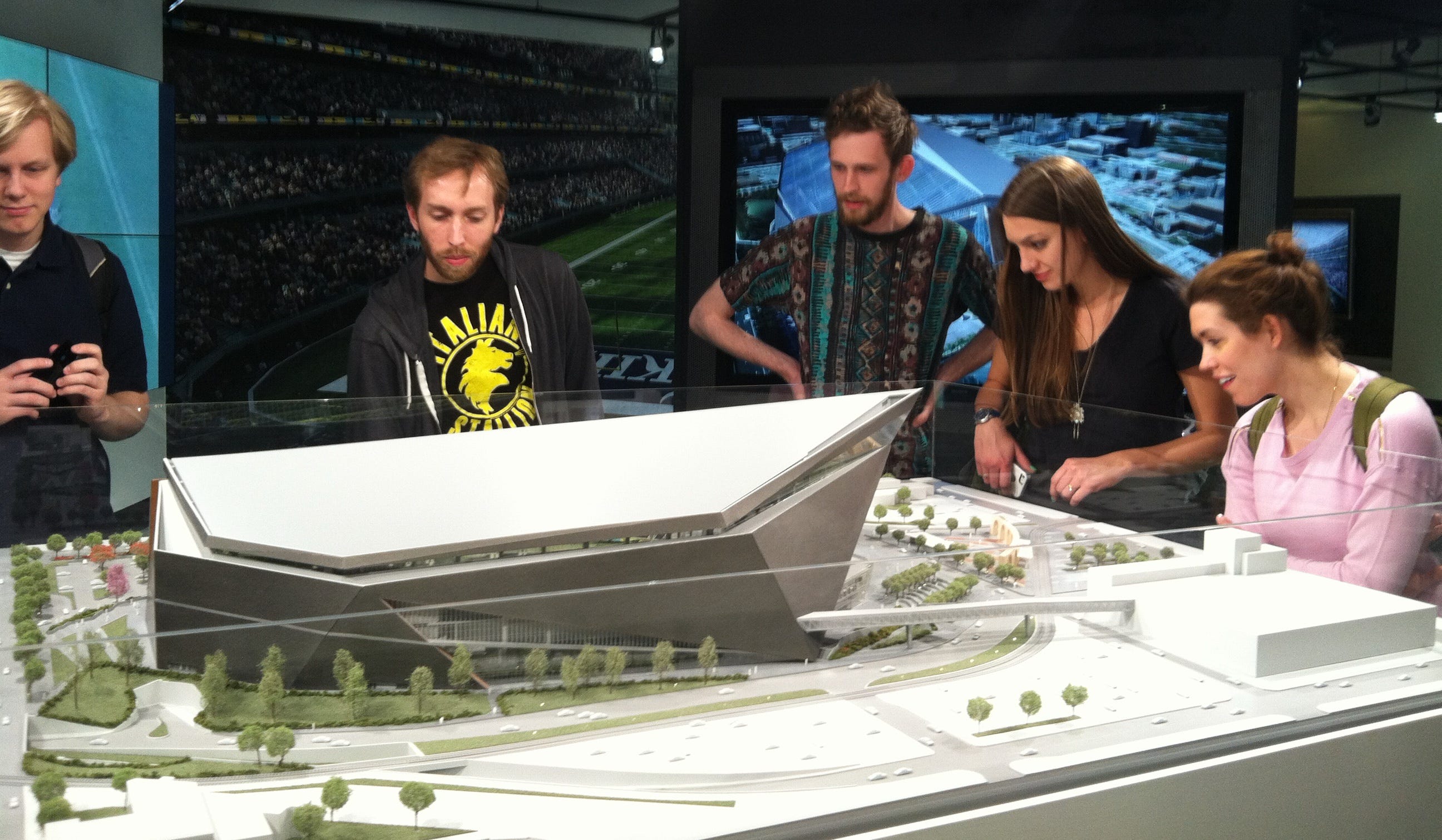
Now that I’ve told you about the Urban Growth Machine, you will find it difficult not to see it operating all around you. Indeed, I’m certain that some of you are thinking, “Wow, that explains a lot of what I’ve been seeing and experiencing in terms of the growth of my city,” and that is because there is always some big project being promoted by the growth machine elites in your town. In Minneapolis, the need for a new NFL stadium for the Minnesota Vikings in 2013 was driven by the fear that the team might otherwise be poached away by Los Angeles unless someone helped pay for a new stadium. And since the Twin Cities is the smallest US market with all the major league sports represented (football, baseball, basketball, hockey, and soccer, as well as women’s basketball and hockey), the loss of NFL football would be psychologically devastating, particularly for the leaders of Fortune 1000 firms, also part of the growth machine, who hope to attract talented employees to our city…and our winters. After all, who would we be without an NFL team? And the Los Angeles Vikings?! Of course, the stadium/ballpark/arena/convention center/etc. story plays out all around the country all the time, based on the same script (see the book, Major League Losers, for example), which promises that huge economic benefits will flow from the new project.
Somebody must be watching over me, because just as I was giving this essay a last round of edits, an item appeared in The Minnesota Star Tribune, offering a perfect illustration of Molotch’s Growth Machine and Boyle’s Urban Propaganda Project. After a failed U.S. bid to attract the World’s Fair Expo to the Twin Cities suburb of Bloomington in 2027 (we lost to Belgrade, Yugoslavia), it was just announced that the city of Lakeville, south of the Twin Cities, has won the opportunity to host Expo 2031, which will be the first International A1 Horticulture Exhibit ever held in the United States. Organizers signed a purchase agreement for a nearly 57-acre site, and plans include an amphitheater, a “secret garden,” a hotel, and an Expo Hall. Wendy Meadley, the Expo 2031 Minnesota USA CEO and board chair, said she was won over by both the parcel available and the suburb of 80,000 residents, which she called “forward-thinking.”
“It’s a city that’s focused on growth,” she said, adding that Lakeville’s leaders and local business organizations are also great. “We were a project before — now we have a site.”
The expo will run between May and October, will cost nearly a billion dollars, and is expected to draw millions of visitors and produce $200 million in state and local taxes and 17,000 jobs. At the risk of irritating my colleagues and friends here in the Twin Cities, I think it’s great that Lakeville is focused on growth, but let’s just say I’ll believe it when I see it.5
“I have argued that virtually all U.S. cities are dominated by a small, parochial elite whose members have business or professional interests that are linked to local development and growth. These elites use public authority and private power as a means to stimulate economic development and thus enhance their own local business interests.”
- Harvey Molotch, in “Strategies and Constraints of Growth Elites” (1988)
“They turn their cities, as active, dynamic units, into instruments for accomplishing the growth goals that will enhance their fortunes. The city becomes, for all intents and purposes, a ‘growth machine.’”
- Harvey Molotch, in “Strategies and Constraints of Growth Elites” (1988)
Molotch, Harvey L., “The City as a Growth Machine: Toward a Political Economy of Place,” in American Journal of Sociology, 82:2, September, 1976. See also, Molotch, Harvey. “The Political Economy of Growth Machines.” In Journal of Urban Affairs, 15(1), pages 29-53, 1993.
Logan, John R. and Harvey L. Molotch. Urban Fortunes: The Political Economy of Place. Berkeley and Los Angeles: University of California Press, 1987.
Jonas, Andrew E.G. and David Wilson, Editors, The Urban Growth Machines: Critical Perspectives Two Decades Later, Albany: State University of New York Press, 1999.
Boyle, Mark, “Growth Machines and Propaganda Projects: A Review of Readings of the Role of Civic Boosterism in the Politics of Local Economic Development,” in The Urban Growth Machines: Critical Perspectives Two Decades Later, Jonas, Andrew E.G. and David Wilson, Editors, Albany: State University of New York Press, 1999.
Adler, Erin, “Expo 2031 chooses Lakeville as host city: The event, to be held May through October, is expected to bring millions of visitors,” The Minnesota Star Tribune, 29 September 2026.