
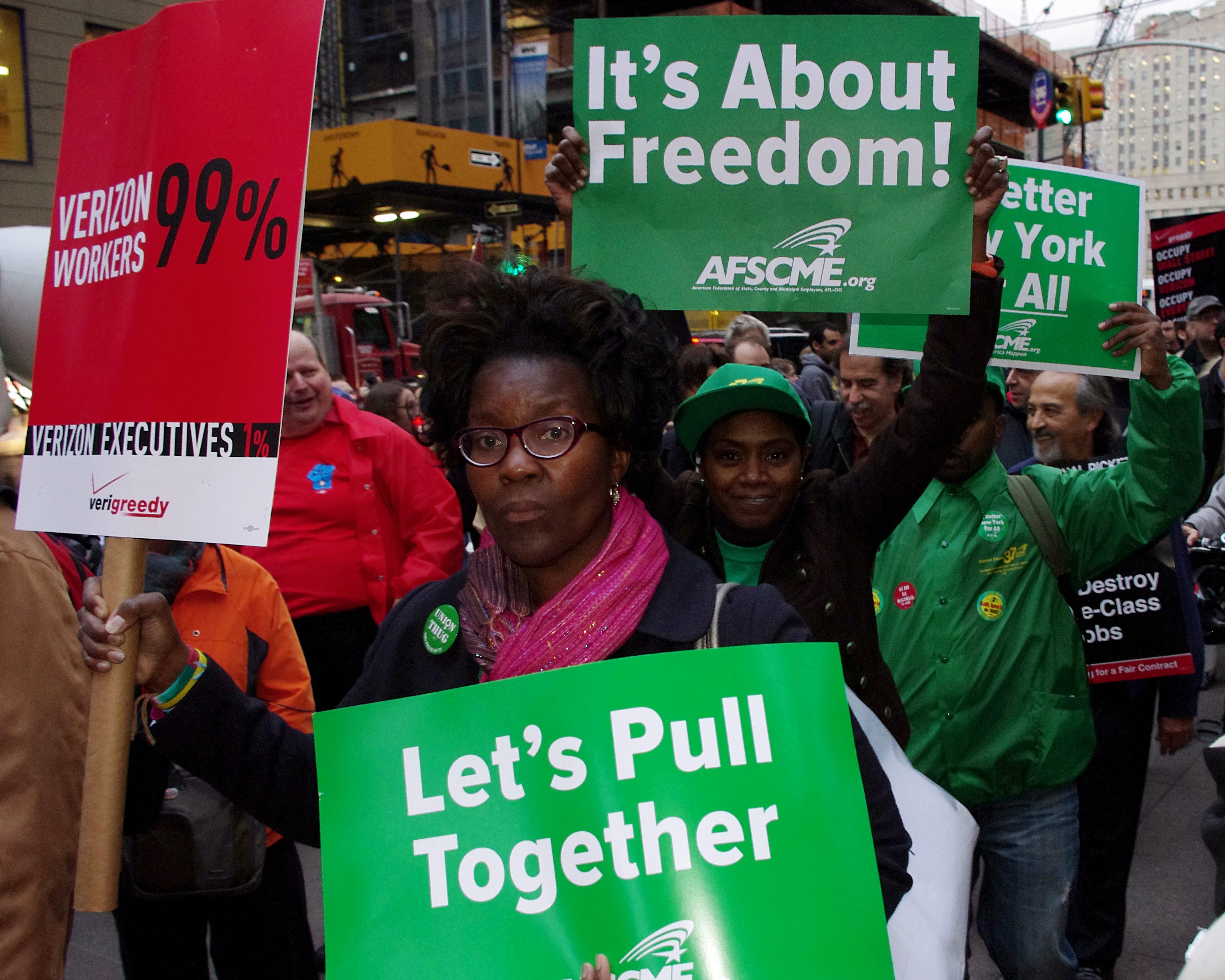

The Story
I never thought much about unions other than having the vague idea that they were bad, which I got from my lifelong Republican father. But my mother was a lifelong Democrat, so it was my good fortune to be raised in a bipartisan household, where, whenever there was an election, my parents would march down to my elementary school to cancel out each other’s vote. I was in college from 1980-85, when President Ronald Reagan (president from 1981-1989) borrowed the template created by the “Chicago Boys” and Pinochet in 1970s Chile, and began instituting a variety of “neo-liberal reforms,” including union busting. Indeed, as if to set the tone for his presidency, one of Reagan’s first big acts in office took place on August 5, 1981, when he fired 11,345 striking air traffic controllers—all unionized federal employees. After college, when I joined the architectural profession, we were all “at will” employees, and the only unionized architects that I knew of were federal, state, and local government employees. In private architectural practice, the attitude was that union membership was beneath us state-licensed professionals and potentially in conflict with our duties and ethical obligations to the public.
So, as you might imagine, going from that world into City Government was an eye-opening experience for me. I was a mayoral appointee, and “non-rep” – which means I was not represented by a union, although I managed union employees. There were a lot of non-rep appointees like me in leadership positions in that administration, but the vast majority of the City workforce was unionized. Police and firemen have their own unions, and many other city workers were represented by the American Federation of State, County, and Municipal Employees (AFSCME), District Council 33 (blue-collar workers) and District Council 47 (white-collar workers). The team I managed had members of both of those unions, with architects and engineers in D.C. 47 and building inspectors and administrative staff in D.C. 33. I had to learn fast, sometimes in unpleasant grievance hearings with employees, union reps, and shop stewards, where we—management—were often the enemy. Yet, despite the challenges of managing unionized employees at the City, I also had several memorable experiences that led me to see unions in a new, more positive light, with the following two stories serving as examples.
Diane was my boss’s administrative assistant, a member of D.C. 33, and a smart, hard-working person who seemed a little distracted and didn’t smile very much. As an aside, the job classification for admins was called “Clerk Steno II,” although stenography had long since gone the way of the dodo bird. One day, Diane left on extended medical leave, and when I asked my boss about it, he told me that she had a serious health condition. Diane continued to receive full pay while she was out and had job protection for when she returned, several months later. I remember thinking, “Wow, how great is it that she can be out for an extended period of time while fighting a terrible illness and not have to worry about the impact on her family of a loss in income, or if she would even have a job when she returned.” This was in stark contrast to my own at-will employment experiences in architecture firms, where there were no unions and every economic depression meant layoffs. I was young and healthy and had never worried about any of these things, but I never assumed I had job security either. Diane went on leave a second time and ultimately died of her illness, but the union provided a safety net that she and other people needed, and that made sense to me.
The second story begins in the summer of 1995, when I broke both bones in my right forearm, and a Nigerian orthopedic surgeon named Enyi Okereke put them back together with 2 steel plates and 14 screws. To get access to the two broken bones, Dr. Okereke made two six-inch-long incisions, one on the inside of my arm and the other on the outside. As those incisions healed, they developed into raised, hard, pink scar tissue – it looked like there were two worms on my arm. A month later, I saw Dr. Okereke for a follow-up exam to see how my arm was healing, and he noticed the scars and said, “That’s interesting, you’ve developed keloid tissue.” When I asked Dr. Okereke what Keloid was and if I should be concerned, he said, “No, it’s just that it is more common for black people to get that.” I’m pretty white, so I said, “What do you think it means?” He said, half-jokingly,
“You may want to talk to your mother…and look into your family tree.”1
A few years later, when I was working for the City, I was leading a project to relocate a big City sanitation facility. We were trying to understand how the dozen or so sanitation facilities around the city worked individually and as a system, which is why, one sunny and hot summer day, a couple of my team members and I found ourselves standing in the middle of a vast concrete lot surrounded by big, metal shed buildings and smelly trash trucks. We stood there listening to a dark-skinned, African American foreman explain how it all worked, and as he pointed around at different things, I noticed long, pink Keloid scars on the outsides of both of his elbows. My sleeves were already rolled up because of the heat, so I held out my own arm so he could see my scars, and I asked him, “What happened to you?” He said that years of lifting trash cans and dumping them into the back of a garbage truck causes a repetitive strain injury that ultimately wrecks your elbow joints. He said,
“Yeah, sooner or later all the guys have to get that operation.”
In that moment, one idea of “labor,” meaning to use up one’s body in exchange for pay, became crystal clear to me for the first time.
The Theory
Karl Marx was the first to argue that those who work for a wage are not being paid for the product of their labor, but rather, for their “labor power.” Labor power is the physical and mental work of the human body over a period of time, for example, an 8-hour workday. In Marx’s view, a worker slowly sells off pieces of their physical existence to earn the wages needed not only to support their family, but to replenish their body, so they can do it all over again tomorrow, until the day comes when their body is all used up. The rise of unions helped workers organize to sell their labor power, but in addition to demanding higher wages, unionized workers bargained successfully for a safer workplace and healthcare. More importantly, the unions’ emphasis on health has been effective.
One study of the health of union members used a large longitudinal data set to illustrate the impact of unionized careers on middle- to older-adulthood mortality in the US, where mortality means “more people are dying than usual.” Unlike more typical point-in-time studies that highlight workplace accidents, the emphasis of this study was on general health over time, and it led to three big findings: Spending more time in a union reduces the odds of mortality by about 15%; union benefits are unevenly distributed, with less educated white men benefiting the most; and union protection typically works up to the age of about 67. The study concluded that union membership means better health for older adults, lower mortality rates, better job quality in midlife, and lower rates of drug deaths.2
Another study, a literature review of the impact of union membership on health in European countries, summarized how unions operate through three mechanisms that correlate with positive health outcomes: Providing better jobs, improving health and safety, and raising awareness among workers. But while there is a significant positive relationship between union membership and the health and well-being of union members, the authors found that the strength of this relationship is proportional to the union’s power. And similar to the previous study, the most vulnerable workers – those with lower wages and less education – experienced greater marginal improvements in physical and mental health. This study concluded that:
“Union members report a higher level of subjective well-being than non-members,” and “There is a positive and significant relationship between union membership and individuals’ well-being.”3
Both studies concluded that union membership is better for the health, well-being, and longevity of workers, and that there is a strong relationship between declining union membership and increased mortality and worse health outcomes for workers, their families, and the general public in the US and Europe.
The Lesson
My parents’ marriage began as the traditional model: The man works and provides for the family, and the woman manages the home and raises the kids. So, my dad was embarrassed when, as my siblings and I left for college one by one, my mom decided to pursue a master’s degree and embark upon a 20-year career as a guidance counselor in public schools. But when my dad was later pushed out of a big company in his 50s, her income and healthcare benefits supported them while he set up shop as an independent consultant. It all worked out in the end, and my 87-year-old mom still receives a pension, which became invaluable after my father passed away. And while my father never quite said it out loud, I know that later in life he appreciated my mom’s public-sector union job and the stability, income, health insurance, and retirement benefits it provided to them.
We live in a rich society: One can imagine how we could easily afford a more comprehensive social safety net that ensured we all had healthcare and housing. And yet, here we all are, still waiting for neo-liberal trickle-down economics to raise all boats, make us wealthy, and eliminate the need for taxes and those silly benefits.
“Unions are an underappreciated social determinant of health.”
- Leigh and Chakalov
“Unions have been the only powerful and effective voice working people have ever had in the history of this country.”
- Bruce Springsteen
“It was the labor movement that helped secure so much of what we take for granted today. The 40-hour work week, the minimum wage, family leave, health insurance, Social Security, Medicare... the cornerstones of middle-class security all bear the union label.”
- Barack Obama
Dedication
I’m dedicating this post to the memory of Dr. Enyi Okereke. Dr. Okereke was a deeply trusted surgeon and a beloved instructor and mentor, and he is also remembered for increasing the number of people of color practicing orthopedics at the Hospital of the University of Pennsylvania. Okereke never forgot where he came from, and every year, he led a healthcare mission back to Nigeria. In 2008, he died of a heart attack at the age of 54 while on one of those missions.
According to Wikipedia, “Keloids are raised, firm, and shiny. They can range from pink to dark brown and often feel itchy, tender, or painful. They are most common in people under 30 and those with brown or Black skin, often running in families. https://en.wikipedia.org/wiki/Keloid
VanHeuvelen, Tom, Xiaowen Han, and Jane VanHeuvelen, “The mortality implications of a unionized career,” in Social Science and Medicine, 365 (2025), 117620, published online 8 December 2024.
Sciarra, Alessandra and Marco Albertini, “The relationship between union membership and workers’ well-being: A systematic review and meta-analysis,” in Transfer: The European Review of Labour and Research, 31 (4) 467-484, 2025