What Entrepreneurial Developers Really Do
Enterprising Individuals + Lucrative Opportunities = Entrepreneurship

The Story
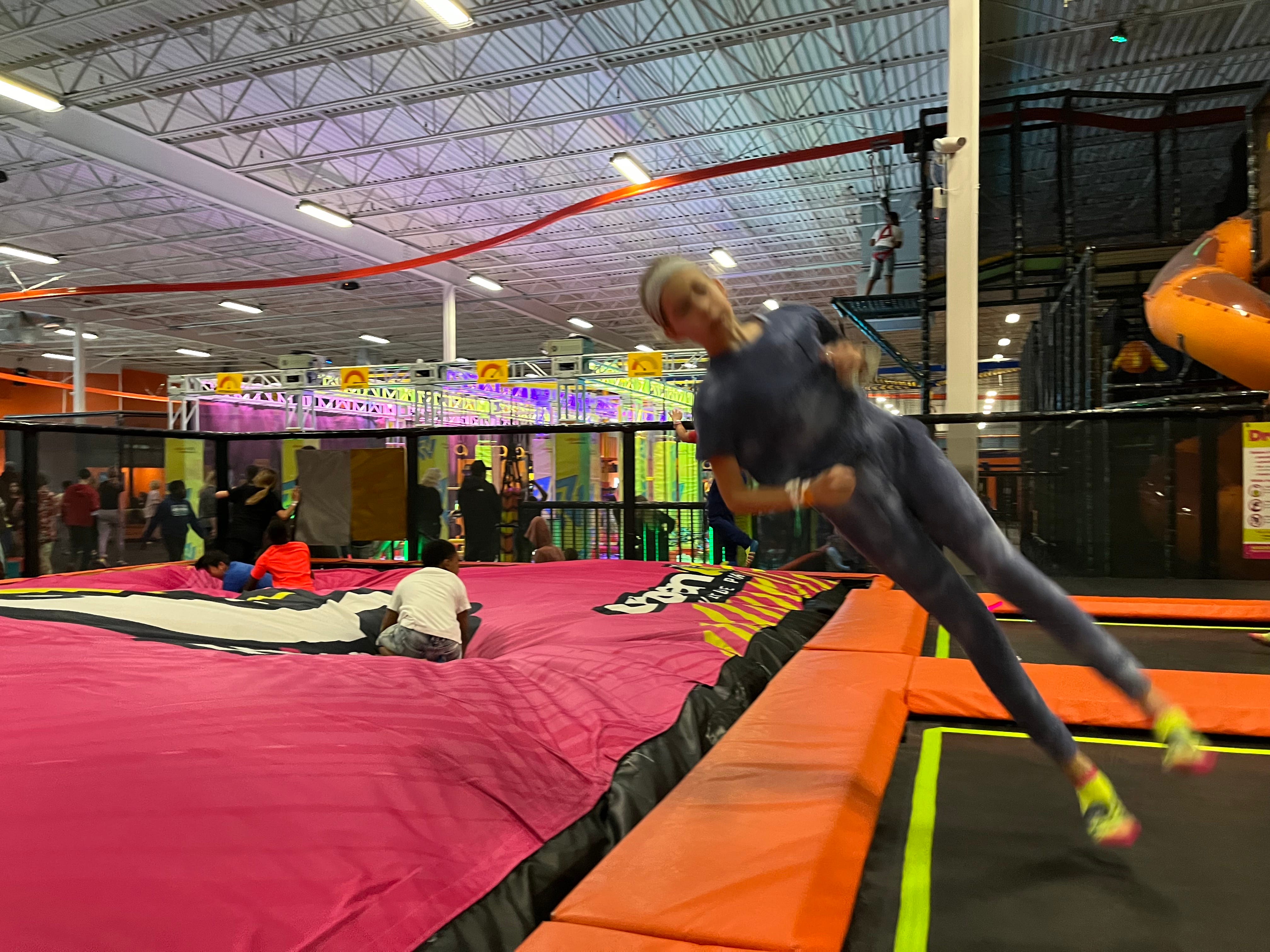
Every week in my private sector development class, I show a picture on the screen, and I ask the students, “What do you see?” It’s always somehow related to real estate development, but it may not be obvious why, at first. One day, I showed a photo of the interior of a Sky Zone trampoline park. Any parent of young kids knows what I’m talking about, because it is where you go for your kid’s friend’s birthday party (and you probably have a pair of Sky Zone socks in a drawer somewhere). Sky Zones are in big, windowless indoor spaces with high ceilings that are filled with one big continuous trampoline. There are some arcade games and a laser tag room, and maybe basketball and dodgeball courts, and even climbing facilities. There is also a cafe that serves pizza and fountain sodas, party rooms for birthdays and other events, and they even cater the pizza and cake. Most of my students went to these places as kids, but don’t quite know what I’m getting at. So let me tell you what I saw.
First, real estate development is more often about redevelopment, rather than the construction of a new building on a green field site. Over time, new things become old and obsolete, and then these undervalued properties are transformed for new uses. I’ve been to a few trampoline parks, and here’s what most of them have in common: They are located in the suburbs, inside former big box stores in those outdoor malls known as “power centers,” or in older warehouses in industrial parks. Changes in retail due to online commerce and other forces mean that when the lease runs out for a Nordstrom or Babies-‘R-Us, they leave abandoned big-box stores behind. For warehouses, product innovation over time means that older, smaller, less flexible warehouses are abandoned for newer, larger ones with higher ceilings, wider bays, fewer columns, and the ability to accommodate higher racking systems. As these new warehouses come online, the older, smaller, lower-ceiling warehouses with lots of columns start to become less desirable or even obsolete. Their rents continue to drop, and sooner or later, their tenants move on to newer warehouses. But what do you do if you are the owner of that abandoned big box store or obsolete old warehouse?
With the growth of dual-career households, busier parents, and higher incomes, kids’ birthdays have changed. When I was a kid, mom baked a cake, ten friends came over with presents, and, after blowing out the candles, we had cake around our dining room table. But who has time to bake a birthday cake these days? Many families have more money than time, and the kids need something to do. Where to go?
In the early 2000s, an entrepreneurial man named Rick Platt, who had previously owned several businesses and most recently been a scrap metal dealer, had a big vision for a brand-new major-league sport that combined, football, basketball, hockey, and Quidditch (from the Harry Potter novels), that would be played 10 or 15 feet in the air, on a big trampoline. In 2004, he scraped together $2 million from friends and family, built a facility in Las Vegas, and had a big game with 3,000 people in attendance, but then the following morning, the question became, “What next?” Then, some kids came by and asked if they could play on the trampoline, and he agreed, but when they asked if they could come back the next day and bring more friends, he said, “Yes, for $8.00 each.” The kids didn’t blink, and pretty soon, there were a lot of people paying to play on Rick Platt’s big, indoor trampoline, and he was in business.
Platt’s son, Jeff, who was 22 at the time, opened a second location in St. Louis, where he had attended business school, because it was a city that was more representative than Las Vegas. His idea was that if an indoor trampoline park sells in St. Louis, it will sell in a lot of other places. Real estate is always a cost, and one way the Platts were able to save on real estate was by leasing cheap space in old big boxes and warehouses out in the suburbs, which happens to be where the kids with money are. Rick Platt’s vision for a new sport never took off, but the trampoline park “family entertainment center” did, and Jeff Platt soon took over from his father as CEO. The company grew, and there were some copycat competitors, but Sky Zone remained the leader. Today, Sky Zone is the world’s largest developer, operator, and franchisor of trampoline and active entertainment parks with a global network of more than 300 locations in 16 international markets, 2,250 employees, and annual revenues exceeding $300 million.1
The Theory
Today, the “cult of the entrepreneur,” which emphasizes the role of the individual, is prevalent in business schools, business, and throughout society, but Scott Shane and Sankaran Venkataraman argue that entrepreneurs do not occur in a vacuum. Rather, two ingredients are required for entrepreneurship to occur: enterprising individuals and lucrative opportunities for them to exploit. Entrepreneurs combine several existing resources or technologies to make an entirely new product in a process known as “joint production.” The goal is to sell the product for a price that exceeds the cost of acquiring those resources, and the difference is the profit. One way they do this is by making different assumptions about the values of those resources than their providers and competitors. For example, an owner of an old industrial building may think its value is based on its current rents as warehouse space, while an entrepreneurial developer might see how the building could generate much higher rents if it were redeveloped as luxury housing units. If the owner thinks it is worth $2 million as is and the developer thinks it is worth $4 million redeveloped, then if he buys it for $2 million, he’s on his way to earning a $2 million profit just from the property acquisition.2
But where do entrepreneurs get their ideas? Shane and Venkataraman explain that we all possess different types and amounts of information, which we combine into our own unique mental frameworks. Enterprising individuals are particularly good at taking a new piece of information that their competitors may not yet have, and fitting it into their thinking in a way that complements their mental framework and helps them identify a new entrepreneurial opportunity. This is how entrepreneurs identify new “means-ends relations,” and “combine existing information and concepts into new ideas.” My favorite example of what this looks like can be found in a sketch called “iPhone Prototype,” which shows a computer, stereo receiver, tape deck, box of tapes, camera, video camera, microphone, and other components stacked up on a luggage dolly, and held together by bungee cords. You can picture it, right? For entrepreneurial real estate developers, joint production means combining land/property, construction services, and professional services, like architecture, engineering, and legal, to produce a unique product in a unique location for a unique price and at a unique moment in time.
In the Sky Zone example, the lucrative opportunity was an unmet demand for family entertainment in the suburbs, and a surplus of vacant big boxes and warehouses. The enterprising individuals were Rick and Jeff Platt, who created the model for an indoor trampoline park and family entertainment center, located in cheap leased spaces in the same suburbs that were filled with families who had more money than time.
Here is one last footnote to the Sky Zone story: My daughter played volleyball for a few years in middle school when, once again, I found myself driving to old warehouses and big box buildings in the far exurbs. Why? Because those buildings are also perfect for girls’ high school league volleyball, which has grown rapidly as a sport. In fact, the last tournament we went to was in an all-new building—a standard tilt-up concrete panel warehouse—that was purpose-built for volleyball courts. So if the demand for girls’ volleyball is so high that they can afford to build new facilities, maybe it’s time to invest in Volleyball. Actually, it’s probably already too late.
Here are three more examples of the formula we can summarize as, “enterprising individuals + lucrative opportunities = entrepreneurship.”
Supertalls: In the past decade, a handful of “supertall” high-rise condominium buildings have been built in New York City. Why? Well, the lucrative opportunity was that there was a growing number of ultra-high net worth individuals (UHNWIs) in the US and throughout the world, who needed safe places to store (or launder) their wealth, and what better place than residential real estate in New York City—with a commanding view of Central Park, to boot? Further, building technologies—structural designs and materials, elevators, and plumbing and mechanical systems—had all advanced enough to allow the construction of much taller residential buildings than ever before. The enterprising individuals were those few seasoned New York developers who understood and had experience with the complicated art of assembling properties and air rights into the developable parcels required to allow high density and extraordinary height. And they knew they could sell $260 million condos to those UHNWIs, make a ton of money, and create legacy buildings that would stoke their already outsized own egos.
Micro Apartments: Very small apartments averaging 150-400 square feet in buildings with shared amenities have become a popular new real estate product in many urban areas, but why? The lucrative opportunity was an unmet demand for affordable rental apartments for young people who want to live close to downtown and urban amenities, where the rents are highest. At the same time, while large, easy-to-develop parcels were becoming increasingly scarce in urban areas, there were still plenty of smaller and odd-shaped remnant parcels that were undevelopable for traditional apartments. The enterprising individuals were those developers who saw that there was demand for smaller units from young people with fewer belongings, who relied on bikes and transit instead of cars, wanted to be close to urban amenities, and for whom the rent or “chunk price” was more important than the actual square footage. Smaller parcels, smaller units, and fewer parking spaces reduced rents for the tenants as well as project costs for the developer, creating a profitable new product.
Office-to-Housing Conversions: In the post-pandemic/office-from-home world, American downtowns face high structural vacancy rates, as many office buildings are largely empty and have lost 50%-95% of their value. At the same time, there is a growing housing shortage in the US. The lucrative opportunity is a high demand for all types of housing, coupled with a huge source of cheap vacant space conveniently located in urban centers, near amenities, and transit. The enterprising individuals are those developers with the experience and confidence needed to attract funding, obtain entitlements, and tackle the conversion of old office buildings that can be bought for pennies on the dollar into new, market-rate and affordable apartments in excellent urban locations.
The Lesson
Instead of a lesson, take this challenge: Next time you see a building, product, or business that looks entrepreneurial, ask yourself this question: Who was the enterprising individual, what was the lucrative opportunity, and how did that individual exploit that opportunity?
“Entrepreneurship isn’t about selling things – it’s about finding innovative ways to improve people’s lives.”
- Richard Branson
Interview of Jack Platt by Andrew Warner of Mixergy, 16 May 2018: https://mixergy.com/interviews/sky-zone-with-jeff-platt/#:~:text=When%20I%20looked%20at%20the,centers%20that%20are%20trampoline%20based; See also the Sky Zone website: https://www.skyzone.com/about-sky-zone/
Scott Shane and Sankaran Venkataraman, “The Promise of Entrepreneurship as a Field of Research,” Academy of Management Review, 25, no. 1 (2000): 218-224.