What happens next?
Anticipatory obedience and the rise of paramilitaries

The Story
I remember well the first time I saw the movie V for Vendetta.1 It was released in the UK in 2005 and came out in the US in 2006. We had recently moved to Minneapolis, and I walked downtown to see it in a movie theater. It occupied my mind during my walk home then, and it has stayed with me for the past twenty years. I’ve seen it two more times since then, most recently, on the Saturday after an ICE agent murdered Renée Good. A week later, this past Saturday, ICE agents murdered Alex Pretti. As a resident of Minneapolis during President Trump’s ICE surge into our city, this movie feels more prescient to me today than when it first came out, but why, and what’s it really about?
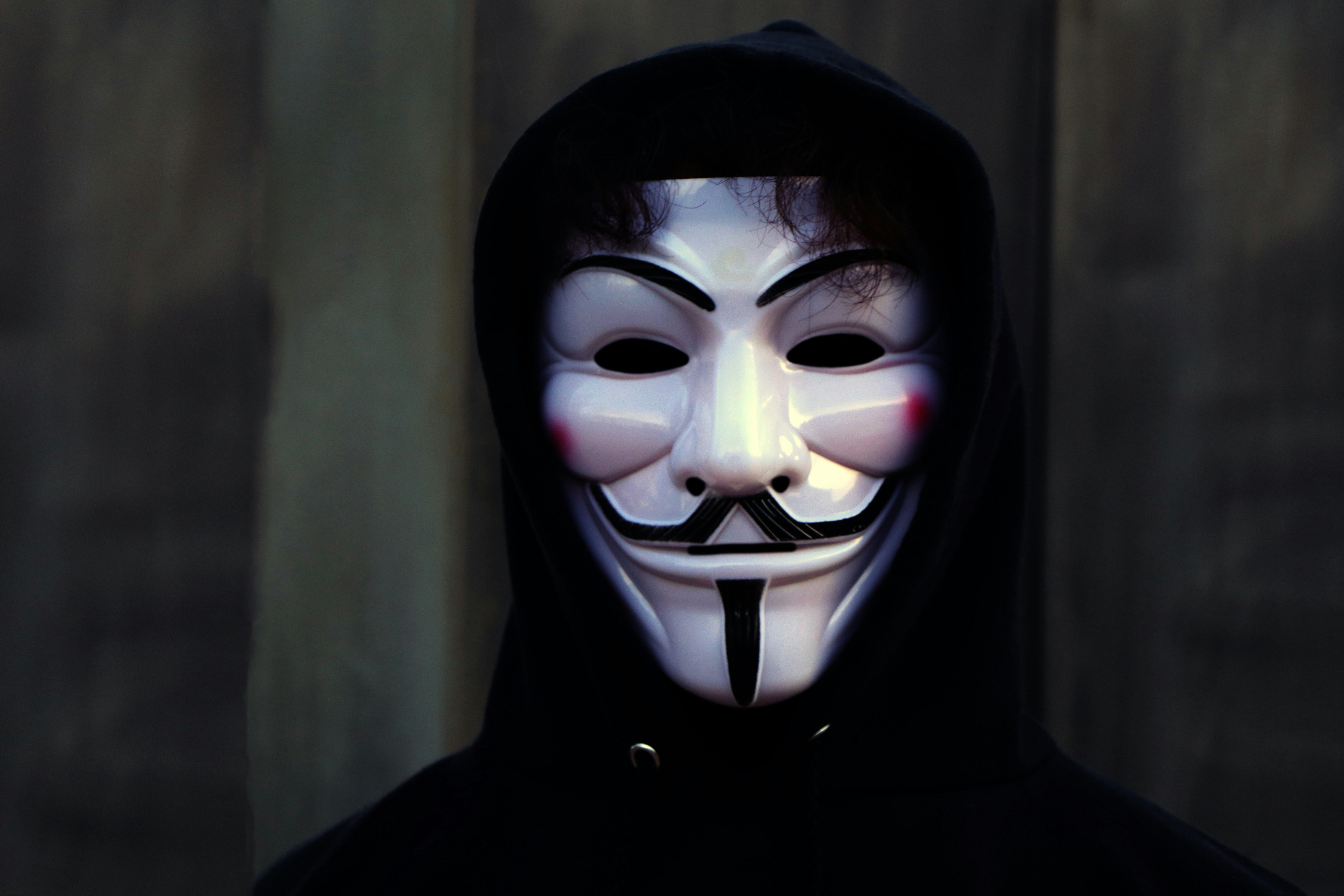
The story takes place in a near-future dystopic London, where a Nazi-like political party called Norsefire has risen to power, led by High Chancellor Adam Sutler, who has seized control of the government and leads a ruthless, fascist, Christian dictatorship that rules Britain. His inner circle, called “the head,” includes five other powerful men, each with a specific responsibility: the “eye” (visual surveillance), “ear” (audio surveillance), “nose” (investigation), “mouth” (propaganda and TV), and “finger” (secret police, called fingermen). Together, these men all rose to power on a conspiracy and a crime committed years before—a series of government-staged “terrorist attacks” and the deliberate release of a virus that killed over 100,000 people and led to nationwide protests. Sutler used the unrest as a justification for imposing martial law, which, years later, remains in place, and Britain has been transformed into a fear-driven police state. All is humming along just fine for Chancellor Sutler and his crew until a character named “V” (played by Hugo Weaving, who played Mr. Smith in The Matrix) makes a dramatic entrance, throwing the Norsefire leadership into fear, paranoia, and chaos. An anarchist who wears a Guy Fawkes mask, a cape concealing an endless supply of big, sharp knives, and superhuman strength, V is the only surviving subject of the regime’s cruel experiments. He knows a few things and has some scores to settle. His goal is to ignite a revolution, awakening the country’s citizens to their responsibilities of self-governance and the opportunity for a better life and society, while destroying Sutler and the Norsefire regime, who do not intend to go down without a fight. This is avery good movie, and it has held up well over time, but two scenes in particular have remained lodged in my memory since the first time I saw it twenty years ago.
First, near the end of the movie, as the citizenry becomes increasingly skeptical of the propaganda they are being fed and their anger at the regime grows, an event signals the turning point. One of the fingermen—a member of the secret police, who are known for their brutal enforcement and lack of accountability—shoots and kills a child running with a Guy Fawkes mask and cape (V has, by now, arranged to have one delivered to everyone in Britain). That’s when a large crowd gets over their fear and complacency and slowly surrounds the agent, some holding makeshift weapons. As the police officer threatens the crowd with his badge and gun, his fear begins to show, and the last thing we see is the first club coming down on him.
The other scene stuck with me for a different reason—because I had only recently moved from the East Coast to the Midwest. In the movie, events are unfolding faster than Sutler and his men can control, and several are watching a television, searching for information. As they rapidly change channels, we see a series of short, grainy news clips. In one, two groups of people appear to run towards one another across a field, while the newscaster announces,
“In the former United States, civil war continues to devastate the Midwest.”
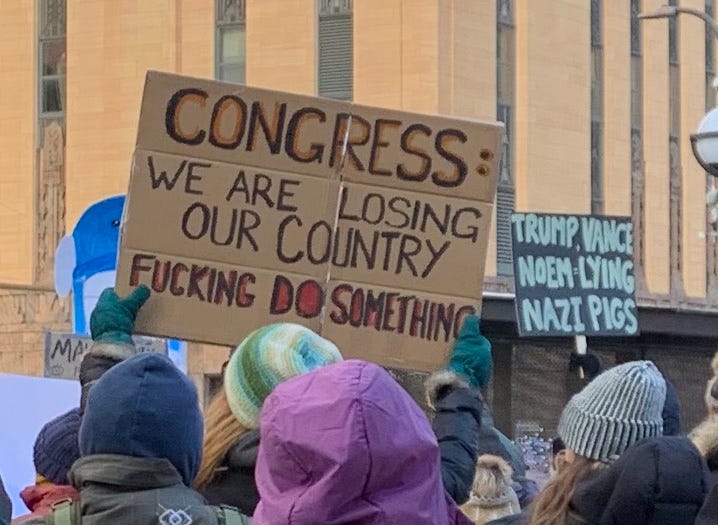
I thought it was funny, back in 2006, because it seemed so implausible. A civil war in the US? Skirmishing in the Midwest? And yet, as I write today, there are 3,000 masked and anonymous ICE agents patrolling the streets of Minneapolis as a part of “Operation Metro Surge,” many violating the constitutional rights of American citizens. If he decides to invoke the Insurrection Act, as he has threatened, the president has another 1,500 Alaska-based active-duty paratroopers who specialize in Arctic operations on ready for deployment, and several hundred Military Police on standby at Fort Bragg, in North Carolina. On January 16, a U.S. District Judge found that ICE agents had likely violated the first and fourth amendment rights of peaceful protesters, and issued an order blocking federal agents from retaliating against peaceful protesters, arresting or detaining people absent probable cause, using pepper spray and munitions as crowd dispersal tools on peaceful demonstrators, and stopping or detaining drivers and passengers of vehicles where there is no reasonable suspicion. One day later, a higher court stayed that judge’s order, allowing ICE to continue with its tactics. Following Pretti’s murder, the state sued again, asking the court to force the federal government to stop the ICE surge. And at the same time, immediately following Good’s murder, the US Departmentof Justice announced investigations into…Minnesota Governor Walz, Minneapolis Mayor Jacob Frey, and Saint Paul Mayor Kaohly Her…for illegally impeding ICE’s activities through their public speeches and announcements. Perhaps most galling and destructive of trust in our institutions is the Federal Government’s decision to exclude state and local law enforcement from investigations of both murders, on top of their full-throated defense of the ICE agents involved and the Vice President’s claim that the agents have “absolute immunity.” As for the abuse and murder of Mineapolis citizens, if you need more details, there is an endless stream of videos on the internet showing how people have been chased, seized, detained, and brutalized, and how Renee Good was shot in the head three times by one ICE agent, and Alex Pretti was shot ten times in the back by another ICE agent while pinned on the ground and unarmed.
So, while the idea of a civilwar in the US and skirmishing out here on the prairie might have seemed funny in 2006, if you live in Minneapolis in January 2026, where an American President has declared war on an American city, it now looks very real. And for anyone who wants to try to argue that we “should not interfere with law enforcement,” and instead we should just “let ICE do their jobs,” as hours and hours of video footage demonstrate, ICE is obviously not trained in law enforcement and seems to be much more interested in breaking the law than in upholding it. More to the point, the surge clearly isn’t about catching and deporting “the worst of the worst” of illegal immigrants, but rather inciting chaos and conflict to justify even more heavy-handed treatment from the Federal Government. Remember, it was the President himself who said the quiet part out loud in a warning to Minnesota’s Democrats:
“FEAR NOT, GREAT PEOPLE OF MINNESOTA, THE DAY OF RECKONING & RETRIBUTION IS COMING!” he added, blaming state Democrats for the unrest.”
- President Donald J. Trump2
The Theory
Timothy Snyder is a prominent academic, historian, and specialist in 20th-century Central and Eastern European history, as well as the Soviet Union and the Holocaust. He is also an expert on authoritarianism and the author of On Tyranny: Twenty Lessons from the Twentieth Century. My father (who was distantly related to Snyder) mailed a copy of this slim but sobering book to me in 2018, and I want to draw your attention to just two of the twenty chapters.3
Chapter One, Do Not Obey in Advance, begins with this epigraph:
“Most of the power of authoritarianism is freely given. In times like these, individuals think ahead about what a more repressive government will want, and then offer themselves without being asked. A citizen who adapts in this way is teaching power what it can do.”
Snyder warns against “anticipatory obedience,” when we instinctively adapt to a new situation without first reflecting on future implications. Like sheep, we follow new rules and accept new constraints and conditions without question. The problem is that each time we do so, the authoritarian has successfully moved the line—permanently—preparing the ground for the next incursion. Snyder cites the famous 1961 experiment by Stanley Milgram, where a student subject would ask questions of another participant they could see through a window, and then deliver a shock to the other participant for each wrong answer (unknown to the student, the shocks weren’t real, and the other participant was acting). The student was told that the strength of the shock would increase with each wrong answer, and as the voltage went up each time, the other participants often pleaded, shouted, and banged on the glass, asking the students to stop. Most students kept going until the victims appeared to be unconscious or dead. The experiment offered chilling proof that most people are willing to check their judgment at the door and unquestioningly follow instructions from authorities, even when it means hurting other people. Snyder’s main point is that for authoritarianism to take root, you need a public that is willing to give it power too easily. Authoritarians push the envelope a little more every day, and every day we don’t stand our ground is a loss of freedom and the strengthening of an authoritarian regime.
Chapter 6, Be Wary of Paramilitaries, begins with this epigraph:
“When the men with guns who have always claimed to be against the system start wearing uniforms and marching with torches and pictures of a leader, the end is nigh. When the pro-leader paramilitary and the official police and military intermingle, the end has come.”
Snyder reminds us that the ability to hold free and fair democratic elections, try cases in court, create and enforce laws, and carry out the government’s business is possible when only the government can legitimately use force. The government begins to lose this “monopoly on violence” when people and parties who hope to undermine democracy and the rule of law create and fund violent organizations that become involved in politics. Ultimately,
“Armed paramilitary groups first degrade political order, and then transform it.”
Snyder expresses amazement at the novelty of a sitting president using his own, separate, personal security force during his campaign, one that also sought to denigrate, manhandle, and expunge dissenters at rallies. Snyder’s warning is this:
“For violence to transform not just the atmosphere but also the system, the emotions of rallies and the ideology of exclusion have to be incorporated into the training of armed guards. These first challenge the police and military, then penetrate the police and military, and finally transform the police and military.”
One last thing about Tim Snyder: In the fall of 2024, around the time of the presidential election, he and his wife, Marci Shore (she specializes in the same areas of study as Snyder and the two are considered an academic power couple), along with a prominent philosophy professor named Jason Stanley, all left Yale and the United States for new positions at the University of Toronto. Perhaps they were following the lesson from German pastor Martin Niemöller’s famous poem, “First they came…,” which was that the biggest mistake was not getting out early.
The Lesson
What do the movie and the current situation in Minneapolis and the US have in common? First, obeying in advance leads to the loss of freedom and allows for the rise of an autocracy. Second, when masked paramilitaries become the secret police, there will be no justice. Third, when the Federal Government can accuse anyone of being a “terrorist” or a “dissenter” without evidence, the gates have been opened to the stripping away of our constitutional rights and indiscriminate violence. And last, yes, we are having a Civil War in America, right now, in the City of Minneapolis.
V’s main point is that the citizens did it to themselves by “obeying in advance,” and the time had come for them to take back their freedom and build a new society. Snyder might add that we are well on the way to doing it to ourselves in the US, and perhaps past the point of turning back. He has certainly voted with his own feet. Our busyness and unwillingness to face hard truths have made us compliant and obedient, and now we can’t see our way back out of it. V’s dramatic actions—I won’t spoil the movie for you—are designed to shock everyone awake and give them the agency required to remake their lives and their society. What would it take to pull us back from the brink of tyranny and an authoritarian dictatorship here in the United States? I highly recommend you watch V for Vendetta and read On Tyranny, perhaps sooner rather than later.
The only person not being investigated for the shooting of Renee Good is the federal agent who shot her.
- Minnesota Governor Tim Walz, after being notified that he was being investigated by the Trump Administration’s US Department of Justice.
“People should not be afraid of their governments. Governments should be afraid of their people.”
- V
McTeigue, James, director, V for Vendetta, Warner Bros., 2005; Wachowski, Larry and Andy, V for Vendetta: Based on the graphic Novel by Alan Moore, shooting script, 2004; Moore, Alan and David Lloyd (illustrator), V for Vendetta (graphic novel), New York, DC Comics, 1990.
Svirnovskiy, Gregory, “Trump warns Minnesota Dems: THE DAY OF RECKONING AND RETRIBUTION IS COMING,” Politico, 13 January 2026. https://www.politico.com/news/2026/01/13/trump-minnesota-reckoning-retribution-warning-00724534
Snyder, Timothy, On Tyranny: Twenty Lessons from the Twentieth Century, New York: Tim Duggan Books, an Imprint of the Crown Publishing Group, Penguin Random House, 2017.